
What Is the Origin of Kombucha (and Where Did It All Begin)?

Kombucha is a fermented tea beverage created by combining sweetened tea with a symbiotic culture of bacteria and yeast, commonly known as a SCOBY. For tea enthusiasts curious about this tangy, effervescent drink that has become a fixture in cafes and grocery stores worldwide, its origins tell a story that stretches back more than two millennia yet remains partly shrouded in mystery.
Most historical accounts trace kombucha to northeast China around 220 BCE, where it was valued for its invigorating and detoxifying effects. The drink held a place in regional Chinese tea tradition long before written records captured its full story, and China remains the most common “origin home base” in kombucha lore. What we know with greater certainty is how kombucha traveled: by the early 20th century, the fermented tea had spread to Russia, then across Eastern Europe and into Germany, where scientific documentation began appearing reliably in the early 1900s.
Understanding where kombucha comes from means grappling with both verified history and the gaps between folklore and fact. This article explores the documented origins of this ancient fermented tea, traces its cultural journey across continents, and examines how traditional brewing methods have remained remarkably consistent even as kombucha has evolved into a global phenomenon. Whether you’re brewing your first batch or simply want to appreciate the tea you’re sipping with deeper context, kombucha’s heritage connects us to centuries of tea culture and fermentation wisdom.
What Kombucha Is: A Definition
Kombucha is a lightly fizzy, tangy fermented tea that sits somewhere between a refreshing drink and a living food. Unlike regular brewed tea, kombucha undergoes a transformation, sweetened black or green tea is fermented by a culture of beneficial bacteria and yeast, creating a beverage with a distinctive sweet-tart flavor, mild effervescence, and a trace of alcohol (typically under 0.5%).
What makes kombucha unique among tea preparations is its fermentation process and the living culture that drives it. Understanding a few key terms helps demystify how this ancient beverage comes to life:
- SCOBY
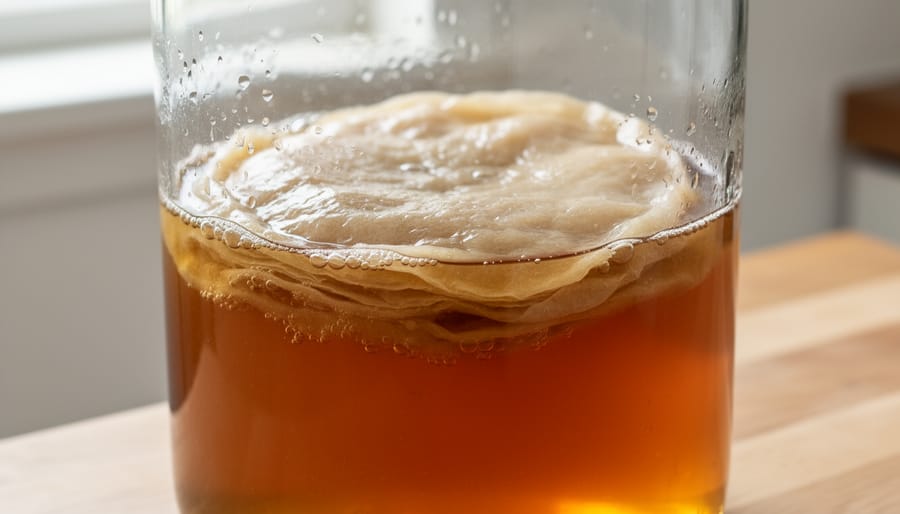
- Short for Symbiotic Culture of Bacteria and Yeast, this rubbery disc or mat floats atop fermenting kombucha and houses the microorganisms that transform sweet tea into the finished drink. Each batch grows a new layer, which can be shared to start fresh brews.
- Fermentation
- The metabolic process where bacteria and yeast consume the tea’s sugar, producing organic acids, enzymes, probiotics, and carbon dioxide. This chemical transformation creates kombucha’s signature tangy taste and gentle fizz over one to three weeks.
- Starter tea
- A portion of finished kombucha from a previous batch, added to fresh sweet tea along with the SCOBY. This acidic liquid jumpstarts fermentation and protects the new brew from unwanted bacteria.
The result is a beverage that tastes bright and complex, imagine a sparkling apple cider vinegar softened with tea, or a tart, lightly sweet cousin to wine. Kombucha’s flavor shifts depending on the tea base, fermentation time, and any added fruits or spices, but its defining characteristic remains that lively, acidic bite balanced by subtle sweetness. This isn’t tea you simply steep and pour; it’s tea that lives, breathes, and evolves.
The Ancient Roots: Tracing Kombucha’s Earliest Origins
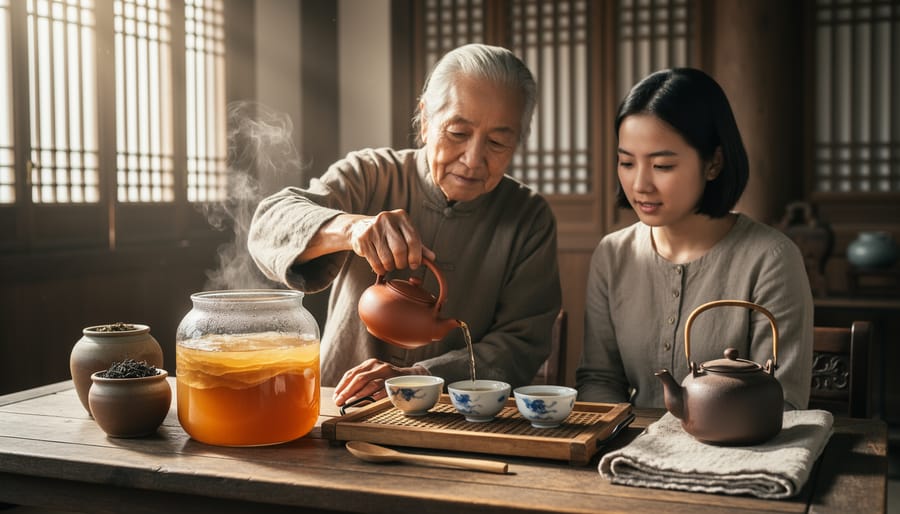
Why Northeast China?
Northeast China’s cultural landscape during the Qin and Han dynasties created conditions that made fermented tea beverages both practical and valued. The region’s tea-drinking traditions merged with a deep understanding of fermentation, already applied to foods like vegetables and grains, making it natural ground for kombucha’s emergence. Historical evidence points to northeast China around 220 BCE as the likely origin, a period when preserving perishables through fermentation was essential.
Why this region specifically? Northeast China’s climate encouraged preservation techniques, and tea had already become central to daily life and medicine. Local cultures valued beverages that supported vitality and digestion, especially during changing seasons. Kombucha fit this need perfectly: the fermentation process transformed sweetened tea into a tangy, effervescent drink that people believed offered invigorating and detoxifying effects.
These perceived benefits weren’t mere folklore. The drink’s probiotic content and organic acids aligned with traditional Chinese medicine principles of balance and cleansing. Kombucha became woven into regional wellness practices, passed between households as both refreshment and remedy, setting the foundation for its eventual spread beyond China’s borders.
The Gaps in Our Knowledge
Despite the allure of kombucha’s ancient story, we must acknowledge how much remains genuinely unknown. No surviving records pinpoint the exact region within China where kombucha first emerged, nor can we confidently name the individuals or communities who discovered this fermentation process. The dates we cite, 220 BCE or the broader span between 200 and 300 BCE, represent educated estimates rather than documented certainties.
Early Chinese texts mention fermented tea preparations, but they rarely describe processes in the specific detail needed to confirm them as kombucha. Traditional knowledge often passed orally through families and communities, leaving no written trace for modern historians to examine. By the time European scientists began studying kombucha systematically in the early 1900s, particularly in Russia, the beverage had already traveled far from its source, and the trail of its earliest days had grown cold.
This scarcity of early documentation doesn’t diminish kombucha’s cultural significance, it simply means we approach its ancient origins with intellectual honesty, separating verified history from the folklore that fills the gaps.
How Kombucha Spread Across Continents
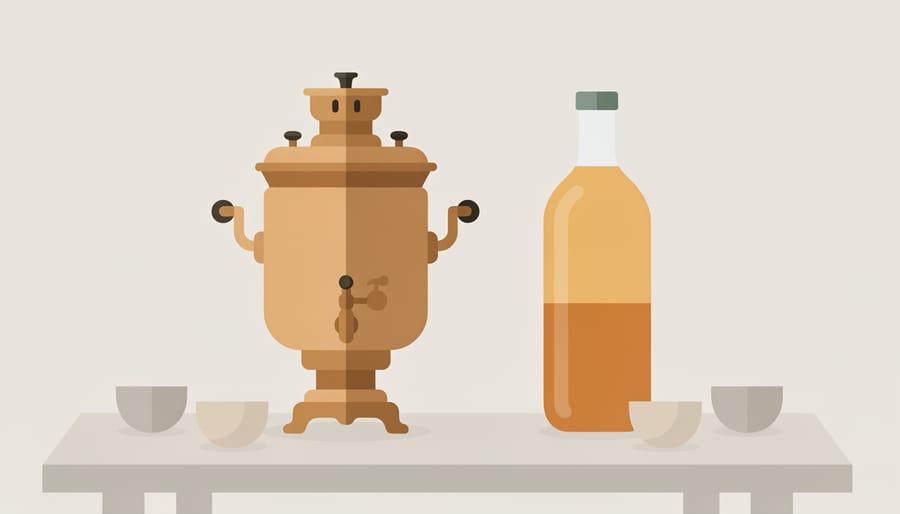
From its ancient home in northeast China, kombucha embarked on a remarkable journey westward along the networks of trade and cultural exchange that connected Asia to Europe. The Silk Road and its countless tributaries carried not just silk and spices, but also knowledge of fermented foods and medicinal traditions. Merchants, travelers, and migrating communities brought their tea-making practices and their carefully maintained SCOBY cultures with them, sharing this living beverage with new regions.
The most documented chapter of kombucha’s migration centers on its early 20th-century spread to Russia where scientific records begin appearing reliably in the early 1900s. Russian families embraced the fermented tea enthusiastically, calling it “tea kvass” and incorporating it into their daily routines. From Russia, kombucha spread throughout Eastern Europe, where household brewing traditions took root in Poland, Ukraine, and the Baltic states. Germany became another strong center of kombucha culture, with detailed fermentation records emerging as the beverage gained a devoted following.
- Ancient China (circa 220 BCE): Traditional preparation begins in northeast China, valued for invigorating and detoxifying effects
- Early 1900s Russia: Scientific documentation emerges as kombucha becomes established in Russian households
- Early 20th century Eastern Europe and Germany: Widespread adoption across multiple countries creates regional brewing traditions
What drove this continental expansion wasn’t just geography. People carried kombucha cultures because they believed in the beverage’s benefits and enjoyed its distinctive tangy flavor. Each household that received a SCOBY “mother” from a neighbor or family member became a new node in an expanding network of fermentation knowledge. This person-to-person transmission, combined with the appeal of a homemade beverage that required only tea, sugar, and time, allowed kombucha to flourish across diverse cultures and climates.
How Traditional Kombucha Brewing Works
Traditional kombucha brewing is surprisingly straightforward, relying on a living culture to transform sweetened tea into a tangy, effervescent beverage. At the heart of this ancient process is the SCOBY, a symbiotic culture of bacteria and yeast that looks like a rubbery, pancake-shaped disc floating on the liquid’s surface. This living colony does all the heavy lifting.
The process begins with brewing a strong batch of tea (traditionally black or green), sweetening it generously, then letting it cool to room temperature. Once cooled, you add the SCOBY and some starter liquid from a previous batch into a wide-mouthed vessel, usually glass or ceramic. Cover it with breathable cloth to keep out dust and insects while allowing airflow, then leave it undisturbed in a warm spot.
Over the next seven to fourteen days, the SCOBY’s microorganisms feast on the sugar, converting it into organic acids, carbon dioxide, and trace amounts of alcohol. This fermentation transforms the sweet tea into a tart, slightly fizzy drink with complex layers of flavor. The bacteria produce acetic and gluconic acids (giving kombucha its characteristic tang), while the yeast creates carbonation and develops aromatic compounds. As fermentation progresses, a new SCOBY layer forms on the surface, a visual reminder that you’re working with living cultures.
What’s remarkable is how consistent this method has remained across cultures. Whether in a Chinese household centuries ago or a Russian kitchen in the 1900s, the fundamental approach stayed the same: tea, sugar, SCOBY, time, and patience. Temperature, fermentation duration, and tea selection might vary by region and preference, but the core process has been preserved through generations of tea drinkers passing along their SCOBYs and knowledge.
This living tradition makes it possible for modern tea enthusiasts to make kombucha at home using techniques that echo those ancient origins.
Types of Kombucha Across Cultures
As kombucha traveled from its Chinese birthplace across continents, it adapted to local tea traditions and taste preferences, creating distinct regional styles that persist today.
In China, traditional kombucha was typically brewed with what would become green tea origins though black tea and oolong tea varieties were also common bases depending on the region. Chinese preparations often featured longer fermentation periods, sometimes extending several weeks, which produced a more pronounced sourness and effervescence. The flavor profiles remained relatively pure, with minimal added ingredients beyond the basic tea and sugar.
When kombucha reached Russia and Eastern Europe by the early 1900s, the brewing culture shifted. Russian kombucha, known locally as “чайный гриб” (tea mushroom), typically used strong black tea, often lower-grade tea that was readily available. Fermentation times ran shorter, usually seven to fourteen days, yielding a milder, slightly sweet-sour beverage. Many Russian households kept their SCOBY perpetually active, passing cultures down through generations like sourdough starters.
German kombucha traditions, which developed shortly after the Russian influence, leaned toward meticulous fermentation control and documentation. German brewers experimented with temperature regulation and precise timing, treating kombucha production almost scientifically. They favored black tea bases but began introducing fruit juices and herbal infusions during secondary fermentation, an innovation that would later influence modern commercial variations.
Each culture valued different aspects of the drink. Chinese tradition emphasized its invigorating and detoxifying effects within daily tea rituals. Russians incorporated it as a refreshing household staple, while Germans approached it with characteristic thoroughness, refining techniques that would eventually inform industrial production methods. These regional variations demonstrate how a single fermented tea tradition can evolve while maintaining its essential character across diverse tea-drinking cultures.
How Kombucha Has Been Used Throughout History
Throughout history, kombucha has served different roles depending on the culture that embraced it. In ancient China, where records first mention the beverage around 220 BCE, people valued it as a daily tonic meant to invigorate the body and support overall vitality. It wasn’t treated as medicine in the modern sense, but rather as a functional beverage, something you drank regularly to feel energized and refreshed.
When kombucha reached Russia and Eastern Europe in the early 1900s, it found a place in folk traditions. Households brewed batches on kitchen counters, passing down SCOBY cultures and recipes through generations. Many families integrated kombucha into their tea-drinking routines, viewing it as a practical way to preserve tea and create something with character. The fizzy, slightly sour profile offered a contrast to plain tea, and the brewing process itself became a small domestic ritual.
Different cultures recognized various tea health benefits in their fermented preparations, though the specific claims varied widely and often reflected local beliefs rather than documented effects. What remained consistent across regions was kombucha’s identity as a living beverage, something distinct from ordinary tea because of its fermentation. People appreciated the tanginess, the slight effervescence, and the craft involved in maintaining a healthy SCOBY culture over months and years.
Common Questions About Kombucha’s Origins
Where did kombucha really come from, and why do the stories vary so much? The answers reflect both established historical evidence and the inevitable mysteries that arise when tracing a beverage across two millennia.
Where does kombucha come from?
Kombucha originated in northeast China around 220 BCE, where it was valued for its invigorating and detoxifying effects. From China, it spread to Russia by the early 20th century, then throughout Eastern Europe and Germany.
What are the most famous origin stories about kombucha?
The most widespread legend attributes kombucha to China’s Qin Dynasty, where it was supposedly served to Emperor Qin Shi Huang. While the timeline aligns with historical estimates, specific details about court physicians or imperial consumption remain part of folklore rather than documented fact.
What does “origin home base” mean in kombucha lore?
China is considered the most common origin home base in kombucha lore, the geographic and cultural starting point from which all other kombucha traditions descended. This recognition reflects both historical evidence and the drink’s deep roots in Chinese tea culture.
Why is kombucha’s exact origin uncertain?
The specific geographic location within China, precise dates, and earliest practitioners remain unknown because written records from ancient times are scarce. Scientific documentation only begins reliably in the early 1900s, leaving earlier centuries to inference and oral tradition.
Understanding these gaps doesn’t diminish kombucha’s rich history. Rather, it reminds us that fermented tea was often a folk practice, passed through households and communities without formal documentation. The SCOBY itself traveled person to person, culture to culture, carrying tradition in a living form that predates written recipes. What we know for certain, China as the birthplace, northeast origins around 220 BCE, and later spread westward, provides a solid foundation even as some details remain beautifully mysterious.
From its misty beginnings in northeast China more than two millennia ago to the bottles lining grocery shelves today, kombucha’s journey reflects both mystery and resilience. We may never pinpoint the exact village or precise moment when someone first discovered that sweetened tea, left to ferment with that remarkable symbiotic culture, could become something entirely new. What we do know is that this living beverage has travelled through trade routes, survived cultural shifts, and adapted to countless regional preferences while maintaining its essential character.
Understanding where kombucha comes from, its ‘origine’, does more than satisfy historical curiosity. It connects us to centuries of tea drinkers who valued this fermented brew for its invigorating qualities and distinct complexity. When you brew your own batch or pour a glass, you’re participating in a tradition that bridges ancient Chinese tea culture with modern exploration.
The gaps in kombucha’s documented history remind us that some of tea’s most treasured practices evolved quietly, passed through communities rather than chronicled in texts. That oral, experiential transmission is part of what makes kombucha special. Whether you’re just discovering this fermented tea or deepening your practice, exploring its origins invites you to taste not just the tang and effervescence, but the centuries of tradition held in every sip.